Lightning Roulette Strategy: 30 Numbers, Payouts & Net Results
Home / Lightning Roulette / Lightning Roulette Strategy
A Lightning Roulette strategy should distinguish covering a winning number from finishing a round in profit. Compare four equal-cost layouts, check the 30-number approach and calculate a specified result with every losing stake included.
There is no layout here that removes the house edge. Original Lightning Roulette pays an ordinary straight-up win at 29:1. In the published operator rules used below, Lightning 100× is a total return of 100 times the winning stake, equivalent to 99:1 profit odds. Adding the stake again would overstate the result.
Lightning Roulette payouts: 29:1 and 100× mean different things
| Bet / specified settlement | Profit odds | Gross return including stake |
|---|---|---|
| Straight-up · ordinary | 29:1 | 30 units |
| Straight-up · matched Lightning 50× | 49:1 | 50 units |
| Straight-up · matched Lightning 100× | 99:1 | 100 units |
| Straight-up · matched Lightning 500× | 499:1 | 500 units |
| Red / black | 1:1 | 2 units |
| One dozen / column | 2:1 | 3 units |
Use the operator payout table together with its 50×–500× definition. The Lightning award replaces the ordinary straight-up return. It is not 29:1 plus a Lightning award, and it does not increase a red, split or dozen bet just because that bet covers the same winning number.
These examples model the original game. They do not certify the Help, stake limits or payout caps of every casino. XXXtreme Lightning Roulette and First Person variants need their own checked rules.
Four Lightning Roulette betting layouts with the same total stake
| Layout | Where the 30 units go | Covered pockets |
|---|---|---|
| A · red | 30 on red | 18 of 37 |
| B · two dozens | 15 on 1–12 and 15 on 13–24 | 24 of 37 |
| C · thirty straight-ups | 1 on each number 1–30 | 30 of 37 |
| D · one straight-up | 30 on number 13 | 1 of 37 |
Coverage counts the pockets on which at least one bet wins. It is not the probability of net profit: a winning bet may merely return the round’s total cost. Layout B can win only one of its two dozen bets, so the losing 15-unit wager still counts.
| Specified outcome | A · red | B · two dozens | C · 1–30 | D · number 13 |
|---|---|---|---|---|
| 8 black · ordinary | -30.00 | +15.00 | 0.00 | -30.00 |
| 13 black · ordinary | -30.00 | +15.00 | 0.00 | +870.00 |
| 13 black · matched 100× | -30.00 | +15.00 | +70.00 | +2970.00 |
| 32 red · ordinary | +30.00 | -30.00 | -30.00 | -30.00 |
| 0 green · ordinary | -30.00 | -30.00 | -30.00 | -30.00 |
For ordinary 13, layout D returns 30 × 30 = 900 gross, then 900 − 30 = +870 net. Layout C returns just 1 × 30 = 30 gross, then 30 − 30 = 0. They covered the same winning number but put different amounts on it.
If that same 13 instead has a matched 100× award, C returns 100 − 30 = +70 net and D returns 30 × 100 − 30 = +2,970. A still loses because 13 is black; B’s dozen payout does not acquire the Lightning enhancement. The examples do not assign probabilities to those awards.
Calculate the gross return and net result for one outcome
Gross return = sum of each winning stake × its total-return factor
Net result = gross return − every stake placed in that round
This is arithmetic for specified, valid settlements. It does not spin a wheel, place a bet, predict an outcome or reproduce a personal account. Invalid/cancelled rounds, table limits, maximum cash awards and currency conversion are outside the model.
Does the Lightning Roulette 30-number strategy work?
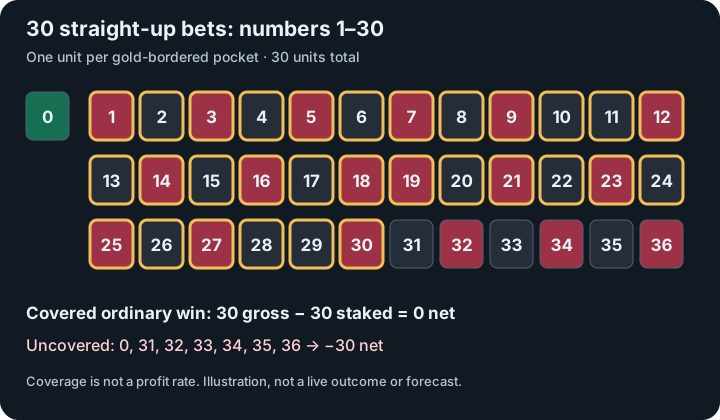
Placing one unit on each of 30 distinct numbers costs 30 units. An ordinary covered win returns 30, leaving zero net. A missed pocket loses all 30. If the covered winner has a 50× total-return award, net is 50 − 30 = +20; at 500× it is +470.
Under an equal-probability single-zero wheel model, 30/37 = 81.08% is the chance of landing in that set and 7/37 = 18.92% is the chance of missing it. Neither number is a measured chance of net profit, because ordinary covered wins only break even. This geometric model is not an estimate of how often each Lightning award occurs.
Across ten hypothetical rounds with eight ordinary covered wins and two misses, the net result is 8 × 0 + 2 × (−30) = −60. One hypothetical 100× covered win replacing an ordinary result adds +70, making that particular sequence +10. A different sequence gives a different total; selecting this winning example does not establish positive expectation.
Covering a different set of 30 pockets changes which outcomes lose, not the 30-of-37 count. Covering all 37 with one unit each costs 37: an ordinary 30-unit gross return then loses 7 net. More winning-number coverage can still produce more rounds with a negative net result.
Why Martingale does not remove the risk
Consider the usual even-money doubling sequence purely as a loss-exposure calculation. Starting with a 1-unit red bet, seven consecutive losses cost 1 + 2 + 4 + 8 + 16 + 32 + 64 = 127 units. The next requested stake is 128, requiring 255 units to fund the sequence through that next bet.
A later 1:1 win recovers earlier losses only if the next stake can actually be accepted and funded. Bankroll and table limits can stop the sequence first. Changing stake size does not change the winning pockets or give the next outcome a memory of earlier losses.
The same doubling slogan cannot be transferred unchanged to layout C: an ordinary covered win returns zero net rather than an even-money profit. A system must account for its actual settlement, not label every covered result a recovery.
RTP, hot numbers and checking a strategy against history
The published operator reference lists 97.10% theoretical RTP for straight-up bets and 97.30% for other bets. These are reference long-run returns, not personal session results. On 1,000 units of illustrative turnover, those rounded values correspond to expected costs of 29 and 27 units; a short session can deviate greatly.
Our Lightning Roulette history distinguishes assigned Lucky Numbers from the matched winning number. A 500× offer on a losing number is not a 500× payout. The archive contains captured third-party settlements, not every player’s stakes, full account returns or a complete official history.
To assess a claimed method, fix the selection rule before the test period; specify every stake, stopping condition, valid award definition and missing-data treatment. Include every loss and compare the same total turnover. Choosing “hot” numbers after seeing the test period introduces hindsight; a high number-match rate alone omits the cost of the other bets.
Use a separate later set of rounds for any follow-up test. This guide does not present its hypothetical examples as a completed betting-system backtest or evidence that a tracker predicts the next spin.
Lightning Roulette strategy questions
What is the best Lightning Roulette strategy?
“Best” needs an objective: more covered pockets, lower stake swings and higher possible single-round returns are different goals. The equal-cost examples make those trade-offs visible; none is demonstrated to beat the game.
Do two dozen bets earn the Lightning multiplier?
No. In the modelled original rules, the Lightning enhancement qualifies a straight-up wager on the winning Lucky Number. A dozen bet keeps its ordinary return even when it covers that number.
Is a 500× result 500 units of profit on a one-unit stake?
Not under the total-return convention used here. It is 500 gross, including the winning unit; profit on that bet is 499 before subtracting any other stakes in the round.
Can I use this calculator for XXXtreme Lightning Roulette?
No. It is labelled for original Lightning Roulette. A similarly named game can have different ordinary payouts and awards; do not transfer the model without checking its rules.
Sources and calculation method
- Evolution: original Lightning Roulette overview
- Published PokerStars-hosted operator rules: definition, payouts and RTP (PDF pages 1, 8–9)
- Play Alberta: published Lightning Roulette rules, independent operator cross-check
Sources accessed 30 October 2026; these published references are not a verification of every current table configuration. The layouts, diagram, scenario arithmetic and comparator are original SpinLogs work. Input unit sizes use at most two decimal places; calculations retain whole hundredths and display two decimals. Check the current in-game Help for real settlements.
Return to recorded results and searchable history · About our data
By SpinLogs · Published and checked . Independent analysis; no next-result or earnings guarantee.
Last updated 30 October 2026