Crazy Time Pachinko: Double, Top Slot & Payout Examples
Home / Crazy Time / Crazy Time Pachinko

Crazy Time Pachinko uses one shared puck drop to settle its bonus bet. This guide explains Double, the matched Top Slot, the difference between a multiplier and net profit, and three recorded examples checked against their visible result displays.
Double increases the board’s prize values; it does not double every bet you placed. Only a qualifying Pachinko wager participates. A displayed or reported final result must not have its Top Slot boost applied a second time.
How the Crazy Time Pachinko bonus works
- QualifyAn accepted Pachinko bet is needed before the wheel result.
- TriggerThe wheel lands on Pachinko. A Top Slot offer alone does not start the bonus.
- Follow the puckA numeric pocket settles the shared bonus result; Double changes the board and prompts another drop.
- Read your settlementApply your qualifying stake and count the other losing bets.
The published Québec rules describe 16 landing multipliers and a randomly assigned drop zone. A matched Top Slot is applied before the drop. When the puck lands on Double, prize values double and the puck is dropped again. The 10,000× ceiling is a multiplier limit, not a promised cash award.
Mechanics reference: published operator rules, Pachinko section. Check the current Help and bet limits in the table you use.
Unlike Cash Hunt, Pachinko does not ask each player to choose a hidden target. The shared puck determines the bonus outcome for qualifying bets. Our tracker has no control over its path or the generated board.
What happens when the puck lands on Double?
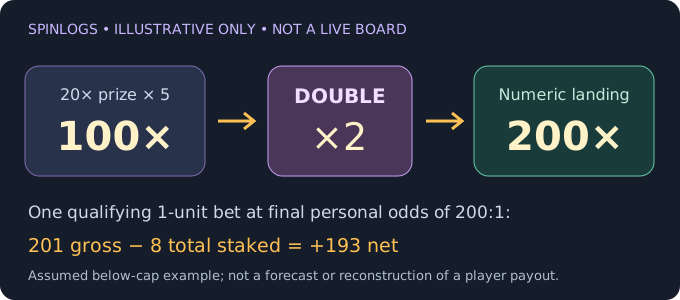
In this example, the chosen 20× prize is first enhanced by a matched 5× Top Slot: 20 × 5 = 100. One Double makes that prize 200; a second would make it 400. A numeric landing ends the illustrated sequence.
This arithmetic stays below the limit. It does not reproduce the game’s random board generation, landing probabilities or full cap behaviour. You cannot infer how many Doubles occurred just by dividing a final result by an assumed starting value.
Is a Rescue Drop the same as Double?
No. The published rules describe an occasional Rescue Drop following low 2×, 3× or 4× results. It is a separate feature, not an automatic repeat a player can demand. A final multiplier alone does not identify whether a rescue or Double occurred.
Pachinko payouts: keep the losing bets in the calculation
| Scenario | Illustrative factors | Final profit odds | Gross return | Net result |
|---|---|---|---|---|
| No enhancement | 20 × 1 × 2^0 | 20× | 21 | +13 |
| Matched 5× Top Slot | 20 × 5 × 2^0 | 100× | 101 | +93 |
| Matched 5×, then one Double | 20 × 5 × 2^1 | 200× | 201 | +193 |
| Matched 5×, then two Doubles | 20 × 5 × 2^2 | 400× | 401 | +393 |
Each example assumes a qualifying 1-unit Pachinko stake and seven other 1-unit bets. Only the Pachinko bet wins in these scenarios. The winning stake is returned in addition to the profit, as described in the published rules.
Gross return = qualifying stake × (final personal profit odds + 1)
Net result = gross return − total stake across all bets
At final personal odds of 100:1, gross return is 101 units, then net is 101 − 8 = +93. If Number 1 lands instead and you held the same eight-spot layout, its 1-unit bet returns 2 and the round is −6 net; the Pachinko stake loses.
A source field called maxMultiplier is not a complete account ledger. Never calculate “600 × 3 = 1,800” merely because a row already reports a final 600× result and a matched 3× Top Slot. Check whether the enhancement is already included.
Three Pachinko recordings: final display versus feed metadata
| Replay | Settlement time | Stored Top Slot metadata | Clip length / checked frame |
|---|---|---|---|
| 8 October 2026 · 400× | No matched Pachinko Top Slot reported | 1:56 · reveal checked near 1:26 | |
| 11 October 2026 · 600× | Source reports a matched 3× Top Slot | 1:52 · reveal checked near 1:24 | |
| 22 October 2026 · 400× | Source reports a matched 20× Top Slot | 1:36 · reveal checked near 1:08 |
8 October 2026 recording: The reviewed clip includes the wheel, the Pachinko board and puck sequence, a visible 400× reveal and the return to the wheel.
11 October 2026 recording: The board and puck sequence are visible, followed by a 600× reveal and return to the wheel. The final display matches the stored 600× result.
22 October 2026 recording: The reviewed clip contains the wheel, board sequence and a visible 400× reveal before returning to the wheel.
Frame times above are positions in the recording, not the bet cutoff or the precise source settlement moment. Inspection confirms the displayed final numbers and visible phases. Top Slot flags in the table are separately attributed to the stored feed; we do not infer a Double count or reconstruct a player’s account from them.
The 600× example and the two 400× examples are different rounds. A similar-looking frame or equal multiplier is not enough to identify an event; use its date, time and event ID.
How often did Pachinko appear in our captured sample?
From 1–29 October 2026 UTC, our archive contains 1,826 Pachinko results among 50,528 Crazy Time settlements: 3.61% of captured rounds. The published wheel table assigns Pachinko 2 of 54 sectors, or about 3.70% for that documented layout. The observed sample and the wheel layout are different measurements.
The archive sample may omit rounds. It is not a complete official game log, a forecast, or a personal return sample. A wait longer than average does not show that the next spin is due to trigger Pachinko.
| Reported value | Captured rounds | Share of captured Pachinko rounds |
|---|---|---|
| Under 10 | 517 | 28.31% |
| 10 to under 50 | 1,132 | 61.99% |
| 50 to under 100 | 80 | 4.38% |
| 100 to under 500 | 95 | 5.20% |
| 500 or more | 2 | 0.11% |
| Not reported / invalid | 0 | 0.00% |
195 rows report a matched Pachinko Top Slot, 1,631 report no match, and 0 have an unknown flag. This does not isolate the effect of boosts or Doubles: board outcomes, missing rounds and assignment selection also matter.
Download the 1,826-row sample CSV: public event ID, settlement timestamp, source final multiplier, source Top Slot multiplier and match flag. Window start is inclusive, end exclusive; each captured event counts once. Data frozen on 30 October.
CSV SHA-256: f82ab9dc64b347bfdc2acc59eea4c02ec33bcef84eebab7d0265a0d74758f7dd. Counts and file are fixed research evidence, not a live daily report.
Pachinko questions that change how you read results
Can Pachinko pay 10,000×?
Evolution documents a 10,000× multiplier ceiling for this bonus. That is different from the frequency of reaching it and from an operator’s cash payout limit. Our 21–22 May 2024 historical record is attributed to its external report, not presented as a video recorded by SpinLogs.
Is the highest prize on the board the result?
No. Check where the puck actually lands and the settled result, rather than selecting the largest number visible before a drop.
Does doubling the stake trigger the Double feature?
No. The bet-size control and the puck landing on Double are different mechanisms. Increasing a stake changes money at risk; it does not select a board outcome.
What is Pachinko’s RTP?
The published reference table lists 94.33%. It is a theoretical long-run percentage, not the chance of a win or a session guarantee. See our dated per-bet RTP reference and weighted model; confirm the current table Help before using a figure.
Is this the separate Crazy Pachinko game?
No. This page covers the Pachinko bonus inside Crazy Time. A separate game’s results or rules should not be merged with this archive.
Sources, method and related guides
Evolution: Crazy Time bonus explanation · Loto-Québec: published Crazy Time rules, pages 4, 6 and 7. The operator PDF is a published reference, not a check of every current casino configuration.
Replay scene checks use the exact public media files and measured durations. The sample uses our captured third-party settlements; illustrations and arithmetic are original SpinLogs work. No personal stakes, balances or payments were available for review.
By SpinLogs · Published and checked . Independent analysis; no next-result or earnings guarantee.
Last updated 30 October 2026